
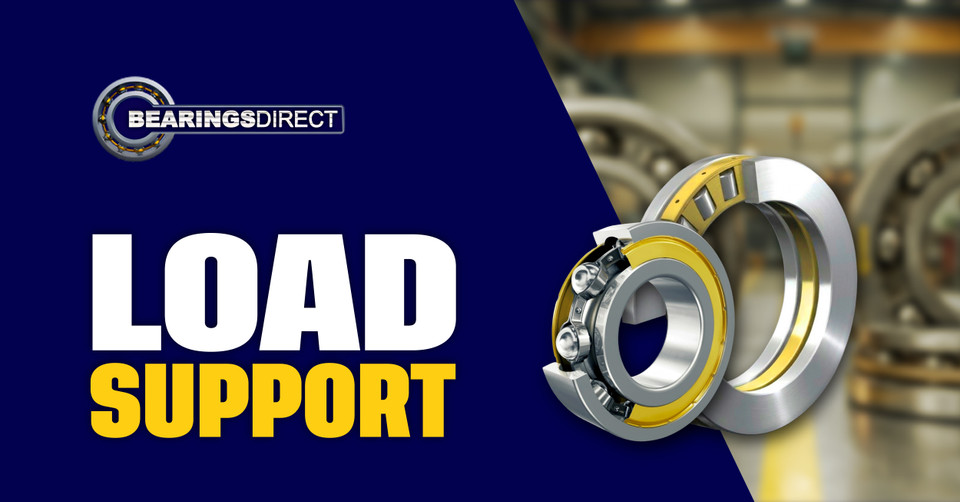
Choosing Between Deep Groove and Thrust Bearings for Load Support
Choosing the correct bearing type plays a major role in equipment performance, safety, and long-term reliability. Deep groove and thrust bearings are two of the most widely used load support bearings, and understanding how they differ helps you avoid failures and choose the right option for your application.
What Is the Difference Between Deep Groove and Thrust Bearings?
The main difference in deep groove vs thrust bearings comes from how each bearing supports load. Deep groove ball bearings are built to handle radial forces and light axial forces, while thrust bearings for axial load are designed specifically to support force along the shaft.
Deep groove bearings use curved raceways that let the balls roll smoothly at high speeds. This design supports strong radial loads and moderate axial loads. Thrust bearings use flat washers and rolling elements arranged to carry axial force in one direction or both, depending on the design.
These structural differences affect speed capability as well. Deep groove bearings work well at high speeds with low friction, while thrust bearings operate at lower speeds because their design creates more sliding and heat.
How Do Deep Groove Bearings Handle Load?
Deep groove ball bearings are the most common radial load bearings used in industrial and commercial equipment. Their raceways keep the balls stable under radial pressure, making them ideal for high‑speed shafts.
They can handle:
- High radial loads
- Light to moderate axial loads
- Continuous high‑speed rotation
Because they generate low friction, they run quietly and stay cool. This makes them a strong choice for deep groove bearing applications such as motors, fans, pumps, and conveyors.
Common materials and designs include:
- Steel and stainless steel
- Open, shielded, or sealed versions
- Single‑row and double‑row options
These variations help you match the bearing to your speed, temperature, and contamination needs.
How Do Thrust Bearings Support Axial Loads?
Thrust bearings are built to support loads that push along the shaft instead of across it. Their structure includes flat washers and rolling elements arranged to carry axial force in one or two directions.
You can choose from:
- Single‑direction thrust bearings
- Double‑direction thrust bearings
Thrust bearings have almost no radial load capability, so they should only be used when the load is primarily axial. They also operate at lower speeds because their design creates more friction under fast rotation.
Two main types include:
- Thrust ball bearings – for lighter axial loads
- Thrust roller bearings – for heavy axial loads and shock forces
These bearings are essential in many thrust bearing applications, especially where stable axial positioning is required.
When Should You Use Deep Groove vs Thrust Bearings?
Choosing between deep groove vs thrust bearings starts with understanding your load direction. Radial vs axial load bearings behave differently, so matching the bearing to the load is essential.
Load Direction
- Deep groove bearings → radial loads
- Thrust bearings → axial loads
Speed Tolerance
- Deep groove bearings → excellent for high‑speed rotation
- Thrust bearings → limited to low or moderate speeds
Space and Mounting
- Deep groove bearings fit into compact spaces
- Thrust bearings require precise alignment
Cost and Maintenance
- Deep groove bearings are generally lower cost
- Thrust bearings may require more frequent checks
This comparison helps you choose the right bearing and avoid premature wear.
What Applications Use Deep Groove Bearings?
Deep groove bearings are used in thousands of machines because they are versatile, durable, and efficient. Common deep groove bearing applications include:
- Electric motors
- Pumps and fans
- Conveyors
- Gearboxes
- General industrial machinery
These bearings offer strong radial load capacity and excellent performance in both commercial and industrial environments.
Where Are Thrust Bearings Commonly Used?
Thrust bearings are used in equipment where axial loads dominate. They provide stable axial positioning and support heavy thrust forces in many industries.
Common thrust bearing applications include:
- Automotive transmissions
- Vertical shafts
- Industrial turntables
- Heavy‑duty equipment
- Marine and aerospace systems
These bearings are essential when your equipment needs strong axial load support and precise shaft positioning.
What Factors Should You Consider When Choosing a Bearing?
A complete bearing selection guide should include the following:
Load Direction and Magnitude
- Radial, axial, or combined loads
- Light, moderate, or heavy forces
Speed and Temperature
- High‑speed rotation favors deep groove bearings
- High temperatures may require special lubrication
Alignment and Mounting
- Deep groove bearings tolerate slight misalignment
- Thrust bearings require precise alignment
Lubrication and Maintenance
- Grease or oil lubrication
- Sealed vs open designs
Expected Service Life
- Duty cycles
- Operating hours
- Environmental conditions
Considering these factors helps you choose the right load support bearings for long‑term performance.
Why Choose Bearings Direct for Deep Groove and Thrust Bearings?
Bearings Direct offers a wide selection of deep groove and thrust bearings for industrial, commercial, and specialty applications. You get:
- A large inventory of both bearing types
- Trusted quality from reliable manufacturers
- Expert support for bearing selection
- Fast shipping and dependable supply
Whether you need bearings for motors, conveyors, gearboxes, or heavy‑duty axial applications, Bearings Direct provides the products and guidance you need.
Get the Right Bearing for Your Load Requirements
Explore the full catalog of deep groove and thrust bearings at Bearings Direct to find the right match for your equipment. If you need help choosing the correct bearing for your load direction, speed, or operating conditions, the Bearings Direct team is ready to guide you.
FAQ
Can deep groove ball bearings handle axial loads?
Yes, but only light axial loads. They are designed mainly for radial forces.
Can thrust bearings handle radial loads?
No. Thrust bearings support axial loads only.
Which bearing is better for high‑speed applications?
Deep groove ball bearings perform better at high speeds.
What happens if I use the wrong bearing type?
You may experience overheating, vibration, premature wear, or complete failure.
Are thrust bearings available in one‑direction and two‑direction designs?
Yes. You can choose based on whether your shaft experiences axial load in one direction or both.
Do deep groove bearings tolerate misalignment?
They tolerate slight misalignment, but not severe misalignment.
Which bearing should I use for vertical shafts?
Thrust bearings are usually the better choice for vertical axial loads.
Can I use deep groove bearings in gearboxes?
Yes, if the load is mostly radial and the speed is high.
Do thrust bearings work well in high‑speed motors?
No. They are not designed for high‑speed rotation.
Where can I buy deep groove and thrust bearings?
You can source both types from Bearings Direct, along with expert support.