
When to Use Open vs Sealed Bearings—and Why It Matters
Choosing between open and sealed bearings may seem like a small detail, but it directly shapes long‑term reliability, maintenance frequency, and total operating cost. Across industrial, automotive, and mechanical systems, the wrong closure choice can shorten bearing life or increase downtime. Understanding how each style performs in real conditions helps engineers and maintenance teams prevent premature failure and optimize equipment performance.
What Is the Difference Between Open Bearings and Sealed Bearings?
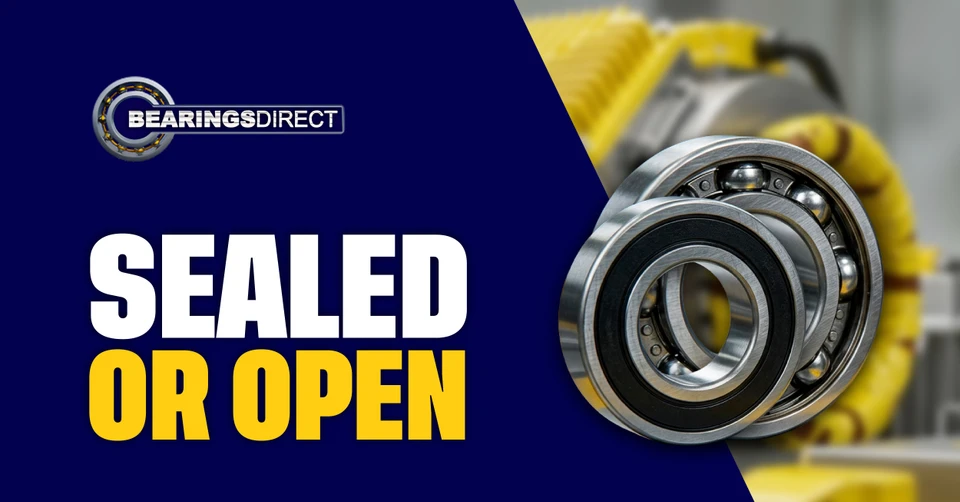
Open bearings contain no seals or shields, meaning their rolling elements are fully exposed to the environment. They depend on the machine’s lubrication system, environmental cleanliness, and maintenance schedule. Sealed bearings, on the other hand, use rubber or polymer contact seals that physically touch the inner ring to retain lubricant and block contaminants. These seals create a built‑in barrier that keeps grease inside and fine particles outside.
Shielded bearings sit between open and sealed designs, using metal plates (Z/ZZ) with a small non‑contact gap. Shields block larger debris and help retain grease while adding minimal friction, though they do not offer full moisture or fine dust protection.
Open bearings allow complete access for lubrication, making inspection and relubrication straightforward. Sealed bearings restrict access but preserve lubrication much longer—ideal for users looking for sealed bearings vs open bearings comparisons that center around convenience, cleanliness, and lifecycle cost. Both categories fit into broader decisions about bearing lubrication types and how equipment manages contamination.
When Should Open Bearings Be Used?
Open bearings are well suited to environments with low contamination. When dust, moisture, and airborne debris are naturally limited—or when the bearing operates inside a sealed gearbox or oil‑bath housing—open designs can offer exceptional longevity. Their simplicity and lack of drag from seals make them ideal for open bearing applications involving high-speed rotation or low‑friction performance.
Because rolling elements remain accessible, open bearings are ideal for machines requiring frequent lubrication. Maintenance personnel can inspect grease condition directly, purge contaminants, or switch lubricants depending on operating temperature or load. SKF emphasizes that relubrication is essential when grease life is shorter than bearing life or when contamination occurs—reinforcing that open bearings align well with adjustable lubrication schedules.
In applications where speed is critical—such as spindles, test rigs, or precision machinery—open bearings minimize frictional losses. With no seal contact, heat generation is reduced, allowing higher RPM and better energy efficiency. This fits neatly into strategies that prioritize long‑term reliability through informed industrial bearing selection and performance tuning.
When Are Sealed Bearings the Better Choice?
Sealed bearings are the superior option when contamination risk is high. Dust, water, process debris, and airborne particulates can quickly reach the raceways of open bearings and create dents, stress points, and premature fatigue. That’s why sealed bearings are recommended in harsh, dirty, or wet industrial environments. Their seals physically block contaminants and retain factory‑applied grease.
When maintenance access is limited—such as conveyor rollers behind guards, HVAC fans high above the floor, or equipment requiring shutdown for service—sealed bearings reduce lubrication demands significantly. Their built‑in sealing system minimizes the need for scheduled relubrication, decreasing labor and downtime. Multiple sources describe sealed bearings as “virtually maintenance‑free,” although regular condition monitoring is still necessary.
Sealed bearings also excel in equipment exposed to washdowns or moisture. In food processing, agricultural machinery, outdoor systems, and material handling lines, operators need dust-resistant bearings that shield internal components from contaminants. Sealed bearings provide that protection and improve reliability in environments where contamination is unavoidable.
How Do Environmental Conditions Affect Bearing Selection?
Environmental factors—dust, moisture, temperature, and chemicals—strongly influence whether open or sealed bearings are suitable. Contaminants cause raceway dents that accelerate fatigue, and lubrication breakdown is faster when debris or water enters the bearing. SKF’s contamination research highlights how fine particles dramatically reduce bearing life, underscoring the need for strong bearing contamination protection in harsh environments.
Indoor machinery may still require sealed bearings if fine dust or mist is present (textile fibers, food powders, machining debris). Outdoor equipment faces humidity, rain, and temperature changes that demand reliable sealing. Shielded bearings may suffice in moderate environments, but sealed units offer the best long-term protection where contamination sources are continuous.
Food-grade and washdown environments place additional demands on bearing closure. High-pressure water, detergents, and sanitizers can rapidly wash out lubrication or introduce moisture unless the bearings use robust contact seals. These real-world conditions make sealed bearings a standard requirement for compliance, reliability, and proper industrial bearing selection.
How Do Open and Sealed Bearings Compare in Maintenance and Lifespan?
Maintenance requirements differ significantly between bearing types. Open bearings rely on consistent lubrication schedules and regular inspection to maintain proper film thickness. Grease or oil must be replenished frequently, especially at higher temperatures or speeds, because lubricant degrades over time. SKF advises relubrication whenever grease life falls below bearing life or contamination becomes detectable.
Sealed bearings reduce this maintenance burden because their seals retain grease more effectively, and contaminants cannot easily reach internal components. This is why sealed designs are often considered maintenance-free bearings—they minimize lubrication tasks while maintaining stable performance. Regular condition monitoring (temperature, vibration, noise) remains important for predicting end‑of‑life.
Under clean, well-lubricated conditions, open bearings may last a long time due to low friction. But in environments where contamination is common, sealed bearings typically offer superior life expectancy. This difference becomes a key factor in any bearing lifespan comparison; it is not the bearing type alone but the environment, lubrication, and load that determine actual service life.
How Do Load, Speed, and Application Demands Influence the Choice?
Load, speed, and vibration determine whether open or sealed bearings deliver better performance. High-speed applications often require low torque and minimal friction, making open or shielded designs the most efficient. Contact seals introduce friction that reduces maximum speed and increases heat, something engineers must consider when specifying bearings for motors, spindles, or fans.
Load capacity is generally similar across bearing closure types, but sealed bearings handle contamination-induced load effects better. Raceways exposed to fine debris experience higher stress concentrations and earlier fatigue. Sealed bearings better protect the load path by preventing contaminants from reaching the rolling elements.
Alignment errors and vibration also influence bearing choice. Open bearings require consistent lubrication to prevent damage under vibration, whereas sealed bearings maintain lubrication and seal integrity better under dynamic loads. These considerations form the foundation of sound industrial bearing selection and align with bearing performance factors used in engineering evaluations.
What Are Common Mistakes When Choosing Between Open and Sealed Bearings?
Using sealed bearings where relubrication is required
Some equipment requires regular grease flushing or circulating oil, and sealed bearings cannot accommodate lubricant changes. In these cases, sealed units may trap degraded grease and shorten bearing life.
Choosing open bearings in contaminated environments
Open bearings fail quickly when exposed to dust, moisture, or debris. Without seals, contaminants enter easily and cause raceway dents that accelerate fatigue.
Overlooking operating temperature and speed limits
Contact-sealed bearings introduce friction and reduce speed capability. Engineers replacing shielded or open bearings with sealed versions must verify allowable speed and operating temperature.
Making cost-driven decisions that shorten equipment life
Open bearings may offer lower upfront cost, but sealed bearings reduce long-term maintenance needs and contamination risks. Choosing solely based on initial cost often leads to higher total cost of ownership.
Why Choose Bearings Direct for Open and Sealed Bearing Solutions?
Bearings Direct offers an extensive selection of open, shielded, and sealed bearings for industrial, automotive, and mechanical applications. The online catalog includes ball bearings, mounted units, linear bearings, and specialty components, ensuring users can match products to specific environments and performance requirements.
Beyond product availability, Bearings Direct provides guidance to help teams avoid premature failures by choosing proper lubrication, sealing, and bearing types. This expert support is especially valuable for maintenance planners, engineers, and procurement teams evaluating equipment upgrades or replacements. Bearings Direct also offers strong inventory levels and fast shipping, making it a reliable source for urgent repair and high‑uptime environments.
FAQ: Quick answers for engineers, maintenance, and procurement
1) What does open vs sealed bearings mean in practical terms?
It’s about whether the bearing has built-in closures. Open bearings have no closures; sealed bearings use contact seals to retain grease and block contaminants.
2) Is sealed bearings vs open bearings a “which is better” question?
Not really. “Better” depends on contamination risk, lubrication method, speed, heat, and service access.
3) When to use sealed bearings for the best ROI?
Use sealed bearings when the environment is dusty or wet, or when maintenance access is limited and downtime is expensive.
4) What are common open bearing applications?
Open bearings are common in clean, protected, well-lubricated housings such as gearboxes or systems with continuous oil lubrication.
5) How does bearing contamination protection affect life?
Contaminants can dent raceways and increase fatigue risk. Research links contamination and lubrication conditions directly to bearing life expectancy and rating adjustments.
6) Are sealed bearings truly maintenance-free bearings?
They often reduce relubrication needs because they retain grease and block contaminants, but grease still degrades and can become contaminated—so monitoring still matters.
7) What bearing lubrication types are common for each closure?
Open bearings often use oil bath, circulating oil, or scheduled grease relubrication. Sealed bearings typically rely on factory grease retained by the seals.
8) What’s the simplest rule for industrial bearing selection?
Match closure type to contamination exposure, lubrication plan, speed/heat requirements, and maintenance access.
9) Are dust-resistant bearings always sealed?
Often yes, because contact seals block fine dust better than non-contact shields. Shields help with larger particles but may not stop fine dust or water.
10) How should you do a bearing lifespan comparison without guesswork?
Compare the environment (contamination), lubrication method, speed/temperature, and service access. Contamination and grease degradation are major drivers of real-world bearing life.
Get the Right Bearing for Your Application the First Time
Selecting the right bearing closure—open, shielded, or sealed—has a direct impact on reliability, maintenance workload, and lifecycle cost. Explore Bearings Direct’s catalog or connect with their support team for help matching bearing type to your contamination exposure, lubrication strategy, load, and speed requirements. The right decision now can prevent failures, reduce downtime, and extend equipment life across your entire operation.
Need help finding the right bearing?
Send your specs or a photo and the team will help you match the correct part.