
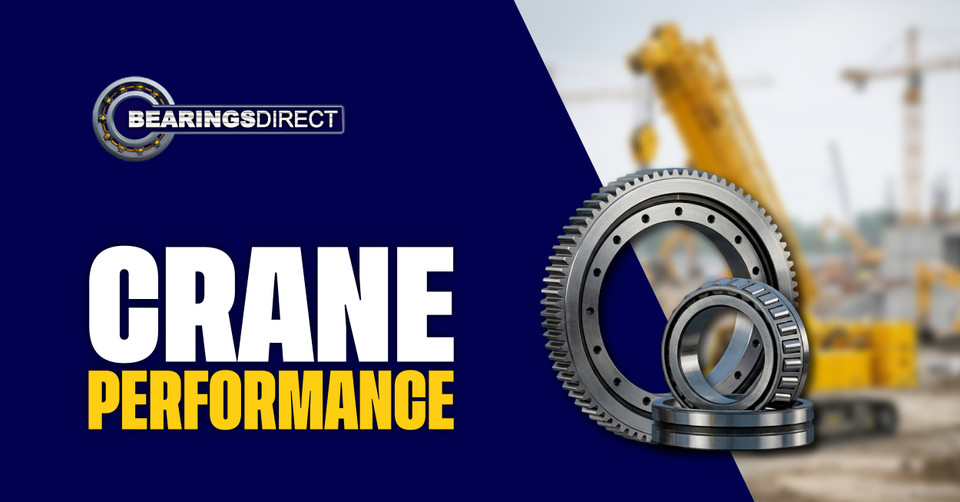
Crane Slewing Ring vs. Tapered Roller: Which Heavy-Lift Application Needs Which?
A single bearing choice can make or break a crane job. When the wrong type is installed, you may face uneven rotation, overheating, or even a full equipment shutdown—costing time, money, and safety. That’s why understanding how each bearing behaves under load is essential for anyone working with heavy-lift machinery.
What Is a Slewing Ring Bearing and How Does It Work in Heavy-Lift Applications?
A slewing ring bearing is a large-diameter bearing designed to support substantial loads while allowing smooth rotation between two structures. In cranes, it’s typically mounted between the base and the rotating upper assembly, acting as the central pivot point.
These bearings are built as a ring with bolt holes for mounting, and many include integrated gear teeth. This design allows the bearing to connect directly to a drive system, creating a compact and efficient solution for rotational movement.
Slewing rings are engineered to handle three major load types at the same time:
- Axial loads (vertical forces)
- Radial loads (side forces)
- Moment loads (tilting or overturning forces)
Because they manage all three simultaneously, slewing rings are essential in cranes and other heavy-duty equipment that rely on stable, controlled rotation.
Common slewing ring configurations include:
- Four-point contact ball bearings
- Crossed roller bearings
- Three-row roller bearings
Three-row roller designs are often used in extremely heavy applications because they separate load paths, increasing stiffness and capacity.
You’ll find slewing rings widely used in:
- Construction cranes
- Excavators
- Wind turbines
- Offshore lifting systems
Anytime your equipment needs controlled rotation under heavy load, slewing rings are usually the best fit.
What Is a Tapered Roller Bearing and When Is It Used in Crane Systems?
A tapered roller bearing consists of two main parts: a cone (inner ring) and a cup (outer ring). Between them sit tapered rollers, which are angled to handle both radial and axial loads. This geometry is what makes tapered roller bearings so effective in heavy-duty applications.
You’ll typically see them in:
- Single-row configurations
- Double-row configurations
- Four-row configurations
Each setup increases load capacity and stability depending on the application.
Tapered roller bearings are ideal for:
- Crane wheels and axles
- Hoisting drums
- Gearboxes
- Drive shafts
They perform especially well in systems where rotation speed is higher than in slewing applications. Unlike slewing rings, tapered rollers are mounted on shafts and require precise alignment. In return, they deliver excellent durability and efficiency in continuous-motion systems.
That’s why they’re a core component in many heavy-duty crane assemblies.
How Do Slewing Ring and Tapered Roller Bearings Differ in Load Handling?
The biggest difference between the two comes down to how each bearing handles load and movement.
Slewing Rings
Slewing rings are designed for large, slow-moving structures. They excel at managing overturning forces—like when a crane lifts a load far from its center. Their ability to handle axial, radial, and moment loads simultaneously makes them ideal for turntable-style rotation.
Tapered Roller Bearings
Tapered roller bearings are built for rotating shafts under high load and speed. They focus more on radial and directional axial forces and are commonly used in drivetrain components, wheels, and hoisting systems.
Here’s a simple comparison to guide your selection:
|
Feature |
Slewing Ring Bearing |
Tapered Roller Bearing |
|
Load Type |
Axial + Radial + Moment |
Radial + Axial (directional) |
|
Rotation Speed |
Slow |
Moderate to High |
|
Rotation Range |
Full or partial 360° |
Continuous shaft rotation |
|
Form Factor |
Large ring |
Compact, shaft-mounted |
|
Load Capacity |
Very high combined loads |
High radial loads |
|
Typical Use |
Crane rotation |
Wheels, gears, shafts |
When comparing load capacity, slewing rings win in complex, multi-directional load scenarios. Tapered rollers win in high-speed, high-radial-load conditions.
Which Crane Applications Call for a Slewing Ring Bearing?
If your crane needs to rotate under load, a slewing ring is usually the right choice.
Common slewing ring applications include:
Tower cranes and mobile cranes. Slewing rings sit at the turntable, allowing the upper structure to rotate smoothly while carrying heavy loads.
Offshore pedestal cranes. These systems rely on slewing rings for full 360° rotation under extreme conditions, including wind, waves, and shifting loads.
Port cranes and ship loaders. These machines deal with high moment loads while moving cargo slowly and precisely.
Material handlers and excavators. rely on continuous partial rotation for accurate load positioning.
These are classic slewing ring applications, where rotation and load complexity go hand in hand. In most cases, the crane slewing ring vs tapered roller bearing decision clearly favors the slewing ring here.
Which Heavy-Lift Applications Are Best Suited to Tapered Roller Bearings?
Not every crane component needs rotational slewing. Many parts rely on high-speed or load-bearing shaft motion instead.
Ideal tapered roller applications include:
Crane travel wheels and bogies These components carry heavy loads while moving across tracks, making tapered rollers ideal due to their high radial load capacity.
Hoisting and winch drums These systems combine axial and radial forces under high torque.
Crane gearboxes and drive shafts These require smooth, high-speed rotation and reliable load handling.
Telehandler boom pivots and knuckle joints These compact points require strong load support in tight spaces.
When deciding between bearing types for crane applications, tapered rollers are the better fit for shaft-based movement rather than platform rotation.
What Factors Should Engineers Consider When Choosing Between the Two?
Choosing between crane bearing types comes down to your application needs. You should evaluate several key factors before making a decision.
Load profile
Are your loads mostly axial, radial, or moment-based? Slewing rings handle all three, while tapered rollers focus on radial and directional axial loads.
Rotational requirement
Do you need full 360° rotation or just shaft rotation? Slewing rings support wide rotation, while tapered rollers are better for continuous spinning components.
Space and mounting constraints
Slewing rings mount between structures using bolts. Tapered roller bearings require shafts, housings, and precise alignment.
Speed
If your system rotates slowly under heavy load, slewing rings are ideal. For faster rotation, tapered rollers perform better.
Environment
Outdoor and offshore conditions demand strong sealing and corrosion resistance. Slewing rings often operate exposed, while tapered rollers are usually enclosed.
These factors are central to smart bearing selection and help prevent costly design mistakes.
What Maintenance Practices Keep Heavy-Lift Bearings Performing Under Load?
Maintenance is critical if you want long bearing life.
Slewing Ring Maintenance
- Regular lubrication of raceways and gear teeth
- Purging old grease to remove contaminants
- Checking bolt torque
- Inspecting seals
Tapered Roller Maintenance
- Correct preload and adjustment
- Proper lubrication
- Monitoring for misalignment
- Checking for uneven wear
In remote or offshore environments, sealed or pre-lubricated options can reduce maintenance needs. These are often used in heavy-duty crane bearings where access is limited.
Consistent maintenance extends lifespan and reduces downtime across all slewing ring applications.
Why Source Heavy-Lift Bearings from Bearings Direct?
When you’re working with heavy-lift equipment, supplier quality matters just as much as product quality.
Bearings Direct offers a wide selection of slewing ring bearings, including four-point contact, crossed roller, and three-row configurations. This range makes it easier to match the right bearing to your application.
They also supply a full line of tapered roller bearings, from single-row units to large multi-row assemblies used in crane drivetrains.
Beyond products, you get technical support. Their team can help you evaluate load requirements, choose the right bearing type, and avoid costly oversizing or undersizing.
Reliable inventory and fast shipping mean you can keep projects moving—whether you’re working on construction sites, ports, or industrial facilities.
Find the Right Bearing for Your Heavy-Lift Application
Choosing between a slewing ring and a tapered roller bearing doesn’t have to be guesswork. When you match the bearing to your load, motion, and environment, you improve performance and reduce risk.
Explore the full range of slewing ring bearings and tapered roller bearings at Bearings Direct, or reach out to their team for expert guidance. You’ll get help selecting the right solution, along with competitive pricing for your next heavy-lift project.
FAQ: Crane Slewing Ring vs Tapered Roller Bearing
1. What is the main difference between slewing rings and tapered roller bearings? A slewing ring supports rotation and multi‑directional loads, while a tapered roller bearing supports high radial loads along a shaft.
2. Which bearing is better for crane rotation? Slewing ring bearings are specifically designed for crane rotation.
3. Can tapered roller bearings handle axial loads? Yes, but usually in one direction. They are often paired to handle loads from both directions.
4. Are slewing ring bearings more expensive? Yes, but they reduce system complexity and replace multiple components.
5. How long do these bearings last? Lifespan depends on load, environment, and maintenance.
6. Can you use both bearing types in one crane? Yes. Slewing rings handle rotation, while tapered rollers support wheels, gears, and shafts.
7. What causes slewing ring failure? Common causes include poor lubrication, contamination, overloading, and improper installation.
8. How do you maintain heavy-duty crane bearings? Regular lubrication, inspection, and correct load management are essential.
9. Which bearing is more compact? Slewing rings provide a compact solution for complex load and rotation needs.
10. How do you choose the right bearing supplier? Look for product range, technicalexpertise, and reliable delivery timelines.