
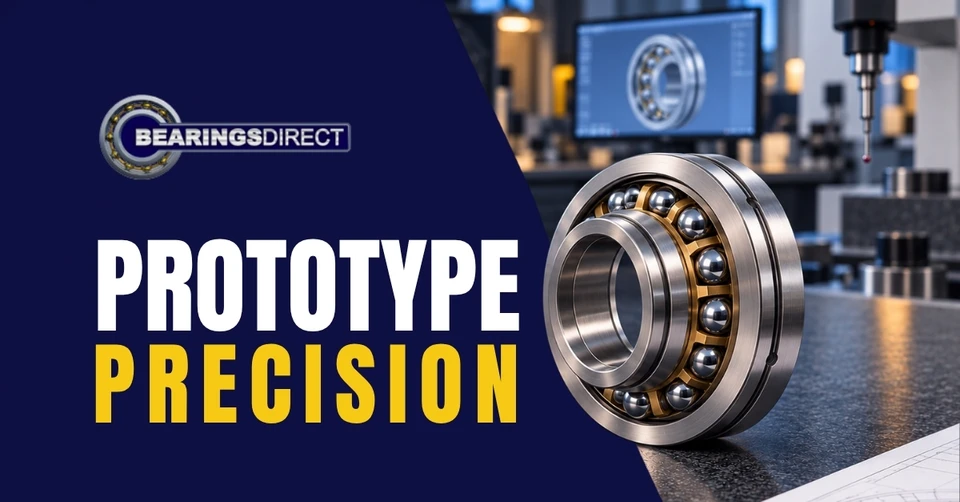
How Bearings Direct Handles Prototyping: From CAD File to First-Off Sample
Skipping or rushing through the prototyping phase introduces severe risks like design flaws, tolerance mismatches, and material failures that often surface only after you commit to a full production run. Treating prototyping as an essential checkpoint protects both your project timeline and your engineering budget well before you scale up operations.
Why Does Prototyping Matter Before a Full Production Run?
For design engineers, OEM designers, and procurement managers, custom component prototyping is far more than a simple step in the manufacturing workflow. It acts as a safety gate that protects your entire project from expensive setbacks.
Catching Design Issues Early
Catching an issue on a 3D digital model is helpful, but physically testing a sample is what prevents true manufacturing headaches. When you manufacture custom bearings or specialized mechanical components, small errors in clearance can cause big trouble. The bearings direct prototyping process helps you identify fit issues, stack-up errors, and material friction problems early on. Fixing a tight clearance on one custom bearing prototyping piece takes very little effort, while fixing that same issue across thousands of finished units can halt production entirely.
Reducing Cost-of-Failure Downstream
The cost of fixing a design flaw jumps dramatically as a project moves closer to mass production. Adjusting a CAD drawing or tweaking a tooling path during early custom component prototyping testing costs almost nothing compared to modifying hard tooling later. Once factory machinery is configured and bulk materials are delivered, making changes gets very expensive. Investing in a first-off sample shields your business from unexpected scrap costs, line shutdowns, and customer returns.
Validating Function, Not Just Geometry
A digital CAD model proves that a part looks right on a screen, but it cannot guarantee how that component handles physical stresses. Physical prototypes let you evaluate real performance factors like operating temperature, vibration, rotational friction, noise levels, and load limits. Validating these functional details under real operating conditions gives your team total confidence in your prototype to production bearings program.
What Happens When You Submit a CAD File to Bearings Direct?
Moving from a digital concept to a physical part begins the moment you share your design files with our team. We guide your design through a careful engineering review to ensure a smooth transition into production.
File Intake and Format Requirements
We make submitting your files simple and quick for CAD to prototype manufacturing tasks. Our engineering systems work with standard 3D file formats, including STEP, IGES, and native SolidWorks files. To speed up our initial evaluation, we recommend including a 2D engineering drawing in PDF format alongside your 3D model. This 2D drawing should show critical dimensions, thread parameters, surface finish needs, and specific material grades.
Design for Manufacturability (DFM) Review
Once we receive your files, our application engineers perform a detailed engineering design review process using proven Design for Manufacturability (DFM) principles. During this step, we evaluate:
- Machinability: We look for deep internal pockets, thin wall sections, or sharp internal corners that might increase tool wear or cause part distortion during low-volume prototype manufacturing.
- Tolerance Feasibility: We check if your required tolerances can be met with standard precision machining or if they need specialized grinding and polishing.
- Material Compatibility: We verify that your selected material can handle the application's operating speeds, temperature shifts, and physical loads.
Clarifying Specifications
If our engineers spot opportunities to improve performance or lower production costs during the engineering design review process, we reach out directly to your design team. We confirm tolerance classes, shaft fits, housing clearances, and surface treatments before any metal is cut. This direct collaboration makes sure we build your rapid prototyping machined parts correctly from the start.
How Does Bearings Direct Turn a CAD File Into a First-Off Sample?
After finalizing and approving all design details, your project moves directly into low-volume prototype manufacturing.
Material Selection and Sourcing
Custom components need exact material traits to perform reliably in demanding environments. Whether your application requires 52100 chrome steel, 316 stainless steel, specialty alloys, or ceramic materials, we source certified raw stock. We check all incoming materials against your chemical and mechanical standards before rapid prototyping machined parts production begins.
Precision Machining for a Single Unit
Creating rapid prototyping machined parts requires both speed and precise accuracy. We do not use temporary or rough shortcuts to make sample components. Instead, we manufacture your first-off sample using the same high-precision CNC machines, tooling setups, and programming approaches intended for prototype to production bearings. This step guarantees that your sample performs just like the final production run.
Quick-Turn Scheduling
We know that product development schedules are tight, and launch deadlines are firm. Our prototype facilities are set up to handle short-run production fast. By prioritizing low-volume prototype manufacturing jobs, we deliver high-quality physical samples quickly so you can keep your testing schedule on track.
What Quality Checks Does a First-Off Sample Go Through?
A physical sample is only as reliable as the quality inspection behind it. We treat first-off sample inspection as a strict quality control requirement.
First Article Inspection (FAI)
Every prototype goes through a thorough first article inspection before leaving our facility. Our quality team creates a ballooned inspection drawing from your 2D print, assigning a unique reference number to every dimension, angle, and note. We then measure the physical sample against every numbered detail on the drawing to ensure complete accuracy.
Dimensional and GD&T Verification
Using calibrated measuring tools like Coordinate Measuring Machines (CMM), optical comparators, and surface roughness gauges, our team completes a full prototype tolerance verification. During this first-off sample inspection, we inspect:
- Linear Dimensions: Inner diameter, outer diameter, overall width, and shoulder locations.
- Geometric Dimensioning & Tolerancing (GD&T): Concentricity, total run-out, perpendicularity, and parallelism across all functional features.
- Surface Finish: Micro-inch surface roughness on all bearing raceways and mounting surfaces.
Documentation and Reporting
We provide full documentation for every prototype we deliver. Each custom bearing prototyping order includes a detailed first article inspection report that your engineering team can review before approving full production. This package includes dimensional measurement sheets with nominal and actual values, material mill test reports showing full material origin, and certificates of conformance for specialized heat treatments or coatings.
How Long Does Prototyping Take, and What Does It Cost?
Understanding turnaround times and project costs helps procurement teams make confident decisions during custom component prototyping.
Typical Prototype Lead Times
Most custom bearing prototyping orders are completed within two to four weeks. The exact timeline depends on raw material availability, required heat treatments, and overall part complexity. If your design relies on standard bearing geometry with minor custom mounting features, CAD to prototype manufacturing turnaround times are often even faster.
Cost Factors for Low-Volume Runs
The unit cost for a single prototype is higher than the unit cost of a large production run. This difference covers individual machine setup, custom CNC programming, dedicated prototype tolerance verification, and short-run material sourcing.
However, view this initial investment as protection for your project. Spending a small amount on low-volume prototype manufacturing prevents thousands of dollars in scrapped production runs, tooling changes, and delayed product releases.
When to Expect Design Iterations
Sometimes initial functional testing shows that a design needs a small adjustment, such as a slightly looser internal fit or a different seal material. When revisions are necessary, our engineering team works quickly to update the CAD files, modify machining programs for rapid prototyping machined parts, and produce new samples without resetting the entire project timeline.
How Does a Successful Prototype Transition to Full Production?
Once your team approves the first-off sample, moving from prototype to production bearings is smooth and straightforward.
Locking in the Approved Design
When you give formal sample approval after reviewing your first article inspection data, we freeze the design specifications in our systems. The exact CAD file version, CNC toolpaths, material sources, and prototype tolerance verification criteria used for your sample are locked in as the official baseline for all future production.
Scaling Tooling and Process
To transition from CAD to prototype manufacturing into volume production, we optimize our manufacturing setup for higher output. We set up multi-part fixtures, automated loading systems, and high-efficiency cutting tools. These updates lower per-unit costs while keeping the final parts identical to your approved first-off sample inspection baseline.
Maintaining Consistency Across the Production Run
Consistency is critical when manufacturing precision bearings. The accuracy verified during prototype tolerance verification is maintained across every batch we produce. We use statistical process control and regular quality audits to ensure every shipping unit meets your exact specifications as you scale prototype to production bearings.
Why Choose Bearings Direct for Custom Component Prototyping?
Picking the right partner for custom component prototyping protects your development timeline, product quality, and budget. The bearings direct prototyping process offers a clear, reliable workflow built around modern engineering needs.
Engineering Support from CAD to Completion
You work directly with dedicated application engineers from your initial file submission through final sample approval. This direct support during the engineering design review process helps solve design challenges quickly and keeps your project moving forward without miscommunication.
Transparent Inspection and Documentation
Complete inspection documentation comes standard with our low-volume prototype manufacturing services. You receive complete first article inspection reports, dimensional logs, and material certificates with your sample, giving you full visibility into component quality.
Responsive, Domestic Manufacturing
Working with our responsive domestic team for rapid prototyping machined parts eliminates common overseas delays, long transit times, and communication barriers. We deliver quick design reviews, fast sample production, and clear updates throughout the entire custom bearing prototyping project.
Frequently Asked Questions
1. What CAD file formats do you accept for prototype submissions?
We accept 3D CAD formats like STEP, IGES, and native SolidWorks files for CAD to prototype manufacturing. We also request a 2D PDF drawing showing key tolerances, surface finishes, and special notes.
2. How long does it usually take to receive a first-off sample?
Most custom bearing prototyping orders are delivered within two to four weeks. Exact lead times depend on material availability, special heat-treating needs, and overall design complexity.
3. What is included in a First Article Inspection Report?
Our first article inspection reports include complete dimensional measurement data, nominal values vs. actual results, material mill test reports, and certificates of conformance for coatings or treatments.
4. Can you help us modify our design for better manufacturability?
Yes. Every submitted CAD file goes through a formal engineering design review process where our engineers suggest tweaks to lower machining costs without reducing performance.
5. Why does a single prototype cost more per unit than a production part?
Low-volume prototype manufacturing unit costs cover individual machine setup, custom CNC programming, dedicated prototype tolerance verification, and short-run material orders that cannot be spread across high production volumes.
6. What materials can you use for custom bearing prototypes?
We work with a wide range of materials for rapid prototyping machined parts, including 52100 chrome steel, various stainless steel grades, engineered plastics, specialty bronze alloys, and ceramic materials.
7. What happens if our sample fails functional testing?
If physical testing reveals a need for design tweaks during custom component prototyping, our engineering team helps update the CAD model, adjust toolpaths, and manufacture updated samples quickly.
8. How do you make sure full production parts match the sample?
We lock the approved CAD revision, toolpaths, and machining parameters into our quality system, using statistical process controls to maintain identical accuracy as you transition prototype to production bearings.
9. Do you offer rapid prototyping for complex geometries?
Yes. Our multi-axis CNC machines and precision grinding equipment allow us to handle rapid prototyping machined parts with complex custom components quickly and accurately.
10. How do we get started with a prototyping request?
You can start the bearings direct prototyping process by submitting your 3D CAD model and 2D engineering drawing through our website quote form or by contacting our engineering sales team directly.
Start Your Prototype with Bearings Direct
Do not risk your timeline and budget on unproven production runs. Partner with Bearings Direct to validate your custom component prototyping designs with speed, precision, and complete first-off sample inspection documentation. Submit your CAD file or request a prototyping quote today to talk with one of our experienced application engineers about your next prototype to production bearings project.