
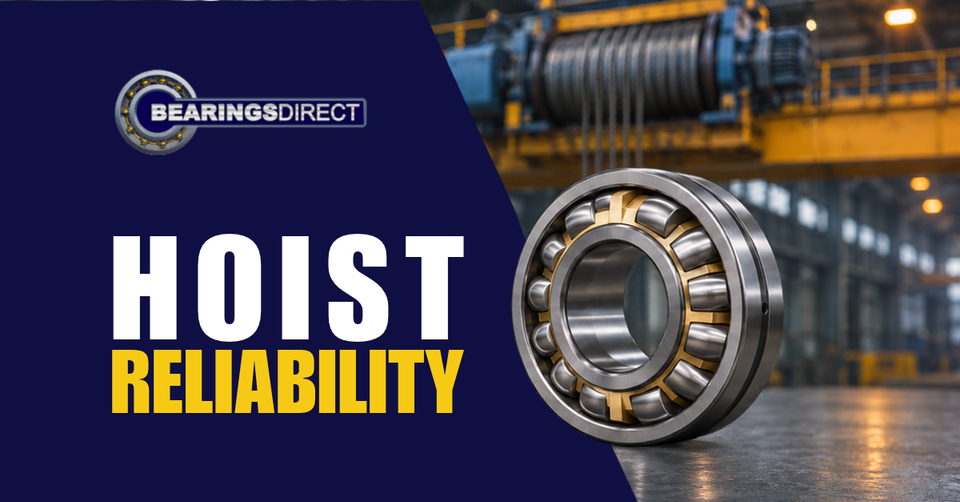
Crane Hoist Drum Bearings: Fatigue Life Calculations for Daily Lift Cycles
Crane hoist drum bearing life depends on repeated lift cycles, changing loads, operating speed, and maintenance conditions. Accurate fatigue-life calculations help maintenance teams select suitable bearings, schedule replacements, and reduce unexpected downtime in safety-critical lifting operations.
Why Does Fatigue Life Matter for Crane Hoist Drum Bearings?
Repeated loading, not just peak load, drives bearing wear
Every lift cycle adds stress to crane hoist drum bearings. Even if the load is below maximum capacity, repeated cycles accumulate fatigue damage. Over time, this repeated loading shortens bearing life.
Unplanned failure costs: downtime, emergency repair, safety exposure
When a hoist drum bearing fails mid lift, the crane stops. That downtime leads to emergency repairs, lost productivity, and safety risks for operators and surrounding workers.
Fatigue life as the basis for maintenance and replacement planning
Fatigue life calculations allow you to predict when bearings will fail. This helps you schedule replacements before failure occurs, reducing downtime and improving safety.
How Is Bearing Fatigue Life Calculated for Crane Applications?
The L10 life concept: the load a bearing can sustain for a stated number of revolutions before fatigue failure
The L10 life formula predicts the point at which 90 percent of identical bearings will still be operational. It is based on dynamic load rating and cycle count.
Dynamic load rating and its role in the calculation
Dynamic load rating (C) defines the constant load a bearing can handle for one million revolutions. Crane bearing dynamic load rating is central to fatigue life calculation for bearings.
Adjusting L10 for speed and operating hours (L10h) to reflect real duty cycles
By converting revolutions into operating hours, you can calculate L10h. This reflects how long a bearing will last under actual crane duty cycles.
What Is a Duty Cycle Classification and Why Does It Matter?
How crane duty classifications categorize load spectrum and cycle frequency
Duty cycle classification crane bearings group cranes into categories based on load frequency and variability. This helps engineers match bearings to actual operating conditions.
Translating daily lift counts and load variability into a duty classification
If your crane performs hundreds of lifts per day, it falls into a higher duty class. That classification requires stronger bearings.
Matching bearing selection to the crane's actual duty class, not just its rated capacity
Hoist drum bearing selection must consider duty class. Choosing bearings only by rated capacity ignores cycle frequency and leads to premature failure.
What Factors Shorten Bearing Fatigue Life in Real World Operation?
Overloading and shock loading beyond rated capacity
Exceeding rated loads accelerates fatigue. Shock loads from sudden stops or drops cause micro cracks that grow into failures.
Contamination ingress and inadequate lubrication
Dust, moisture, and poor lubrication reduce bearing life. Contamination causes abrasive wear, while insufficient grease increases friction and heat.
Misalignment and improper mounting
Improper installation creates uneven load distribution. Misalignment increases stress on certain bearing points, shortening life.
Heat buildup from continuous duty cycling
Continuous operation without cooling raises bearing temperature. Heat accelerates material fatigue and reduces grease effectiveness.
Which Bearing Types Are Used in Crane Hoist Drums?
Spherical roller bearings misalignment tolerance and heavy radial load capacity
Spherical roller bearings crane hoist applications handle misalignment and heavy radial loads. They are common in drum ends where alignment shifts occur.
Tapered roller bearings combined radial/axial loading in drum end applications
Tapered roller bearings hoist drum assemblies manage both radial and axial loads. They are ideal for drum ends that experience thrust forces.
Selecting bearing type and size based on calculated fatigue life targets, not just physical fit
Choose bearings based on fatigue life calculations. Physical fit alone does not guarantee durability under daily lift cycles.
What Maintenance Practices Help Bearings Meet Their Calculated Fatigue Life?
Lubrication intervals matched to duty cycle and environment
Lubricate bearings according to duty cycle. High frequency cranes need more frequent lubrication.
Vibration and temperature monitoring to catch early stage fatigue
Monitor vibration and temperature to detect early fatigue. Overhead crane bearing maintenance relies on these checks.
Proper lockout/tagout protocols during inspection and bearing replacement
Follow lockout/tagout procedures during maintenance. This ensures safety while inspecting or replacing bearings.
Recognizing early signs of spalling and fretting corrosion before catastrophic failure
Look for spalling and fretting corrosion. These are early signs of fatigue failure.
How Do Counterfeit or Substandard Bearings Undermine Fatigue Life Calculations?
Fatigue life calculations assume genuine dynamic load ratings counterfeit bearings often don't meet them
Counterfeit bearings crane equipment risk is high. They often fail to meet dynamic load ratings, invalidating fatigue life calculations.
Inconsistent material and manufacturing quality accelerates spalling and premature failure
Substandard bearings use poor materials. This accelerates spalling and reduces fatigue life.
Total cost of ownership impact cheaper upfront cost vs. shortened service life and unplanned downtime
Cheap bearings seem cost effective but lead to higher costs. Shortened service life and downtime outweigh savings.
Why verified sourcing matters for safety critical lifting equipment
Always source bearings from verified suppliers. Safety critical equipment requires reliable components.
Why Choose Bearings Direct for Crane Hoist Drum Bearings?
Quality assured spherical and tapered roller bearings with verified load ratings
Bearings Direct offers spherical and tapered roller bearings with verified ratings. These bearings meet fatigue life requirements.
Application support for duty cycle based bearing selection
You get support for duty cycle classification. Bearings Direct helps match bearings to crane duty cycles.
Reliable supply for fleet maintenance and replacement planning
Bearings Direct ensures reliable supply. This helps you plan maintenance and replacements without delays.
Source Verified Crane Hoist Drum Bearings for Reliable Lift Performance
Consult Bearings Direct's crane and hoist bearing catalog. Match bearing selection to your crane's fatigue life requirements and ensure reliable lift performance.
FAQ
1. What is fatigue life in crane hoist drum bearings?
It is the predicted lifespan of a bearing under repeated load cycles before failure.
2. How is L10 bearing life calculated?
It uses dynamic load rating and cycle count to predict when 90 percent of bearings remain operational.
3. Why does duty cycle classification matter?
It matches bearing selection to actual lift frequency and load variability.
4. What factors shorten bearing fatigue life?
Overloading, contamination, misalignment, and heat buildup.
5. Which bearings are common in hoist drums?
Spherical roller bearings and tapered roller bearings.
6. How does lubrication affect fatigue life?
Proper lubrication reduces friction and heat, extending bearing life.
7. What is the risk of counterfeit bearings?
They often fail to meet load ratings, leading to premature failure.
8. How can vibration monitoring help?
It detects early signs of fatigue, allowing planned maintenance.
9. Why is verified sourcing important?
It ensures bearings meet safety and fatigue life requirements.
10. Where can you buy quality crane hoist drum bearings?
Bearings Direct offers verified, quality assured crane hoist drum bearings.