
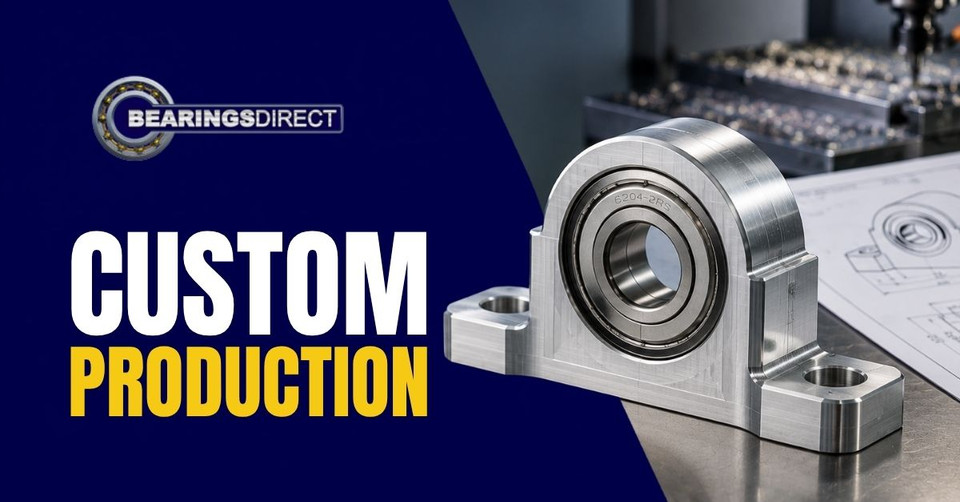
When you need a small batch of custom bearing components for a prototype or pilot run, receiving a quote loaded with thousands of dollars in upfront tooling fees can instantly stall your project. Traditional manufacturing models are built to reward massive production volumes, but you can bypass these steep financial barriers by choosing modern, tooling-free production methods designed for low minimums.
Why Do Traditional Custom Manufacturers Charge Tooling Fees for Small Orders?
To beat the high cost of industrial manufacturing, you have to look at why traditional machine shops structure their quotes the way they do. It almost always comes down to the physical hardware required to jumpstart a classic production line.
Amortization of Setup Costs
Traditional manufacturing heavily relies on hard tooling, which includes specialized molds, stamping dies, and custom work-holding fixtures machined from hardened steel. Designing, cutting, and polishing these tools can take weeks and cost thousands of dollars before a factory ever produces a single part. In high-volume settings, a supplier spreads this massive, fixed cost across hundreds of thousands of pieces—a process known as tooling amortization. If a tool costs $10,000 and you order one million parts, the tooling cost breaks down to just one penny per part. However, if you only need a small batch custom parts run of 50 units, that same tool adds a staggering $200 to the price of every single component.
Mismatch with Low-Volume Needs
Traditional factories build their entire workflows around massive, uninterrupted production runs. Setting up their heavy machinery for a specific job requires hours of manual calibration, alignment, and test runs. When a machine sits idle during a complex setup, the factory loses money. Because of this, traditional suppliers charge high fees that custom parts no tooling fees alternatives cannot match, simply to guarantee a profit on short runs. They are essentially forcing small-batch buyers to subsidize the heavy setup costs and machinery downtime originally meant for high-volume jobs.
Impact on Prototyping and Pilot Programs
These upfront engineering and tooling fees create a massive bottleneck during early product development. High entry costs actively discourage innovation, forcing design engineers to stick to restrictive standard catalogs rather than creating optimized custom components. If every single design iteration requires a new $5,000 mold, your engineering team will naturally test fewer ideas, perform fewer real-world trials, and potentially settle for a subpar design just to keep project costs under control. This financial burden can slow down your entire pilot program, drain your research and development budget, and significantly delay your product's time-to-market.
What Manufacturing Methods Allow Low-Minimum Orders Without Tooling Fees?
The good news is that modern manufacturing technology has evolved past the need for fixed hard tooling. Advanced, flexible production techniques make tooling-free custom manufacturing an affordable reality for businesses of all sizes.
|
Manufacturing Method |
How It Eliminates Tooling Fees |
Ideal Application |
|
Advanced CNC Machining |
Relies on digital code and highly adjustable modular clamping systems. |
High-precision custom bearing prototypes and final-use mechanical components. |
|
Additive Manufacturing |
Prints parts layer-by-layer directly from digital 3D computer models. |
Complex geometries, initial space-fit testing, and rapid prototyping. |
|
Standard Component Modification |
Alters standard stock parts using precision toolroom lathe or mill work. |
Fast turnarounds on custom components with non-standard grooves or bores. |
CNC Machining and Modular Fixturing
Modern computer numerical control (CNC) machining serves as the ultimate backbone for low volume manufacturing bearings. Instead of creating a custom mold to cast a part, a high-speed CNC mill or lathe precisely carves the component directly from a solid block of raw material. To hold the material securely during this process, advanced shops utilize modular fixturing; adjustable, universal clamping blocks that machinists can quickly reconfigure for almost any geometric shape. Because the entire setup relies on software programming and reusable clamps, there is absolutely no need to spend time or money building dedicated hard tooling.
Additive Manufacturing for Prototypes
3D printing and industrial hybrid additive processes construct parts layer-by-layer directly from your digital CAD files. This process requires zero physical molds, templates, or dies. It has become one of the most reliable methods for producing custom parts for prototyping. Design engineers can quickly print a highly detailed bearing housing or specialty collar to test its fit and clearance within a larger mechanical assembly before committing to final metal production.
Standardized Modular Components
Another highly effective strategy to avoid tooling fees is to modify existing standard components. Rather than manufacturing a custom bearing entirely from scratch, a specialized supplier can take a mass-produced stock bearing and use precision grinding or wire EDM (electrical discharge machining) to alter an internal diameter, add a snap-ring groove, or apply a performance-enhancing coating. This hybrid approach combines the extreme affordability of mass-produced bases with the exact dimensional needs of your custom application.
How Can Engineers Source Small Batch Custom Bearing Components?
Securing low minimum order custom components without getting hit by hidden fees requires a tactical approach to how you specify your designs and select your manufacturing vendors.
Defining Specifications Early
To keep your production costs as low as possible, nail down your exact technical specifications early in the design cycle. You must clearly identify your target dimensional tolerances, operational loads, rotational speeds, and environmental conditions like temperature or moisture exposure. Over-specifying a part—such as demanding a hyper-precise tolerance where a standard one would work perfectly—unnecessarily increases machining time and drives up your price. Clean, realistic technical drawings allow your supplier to choose the fastest, most cost-effective tooling-free path for your order.
Choosing Suppliers with Flexible MOQs
Not all manufacturing companies use the same business model. While massive overseas factories optimize their lines for million-unit automotive runs, specialized shops tailor their operations for small batch production for OEMs. When vetting prospective vendors, look closely for those that proudly advertise flexible minimum order quantities (MOQs) or offer a dedicated no MOQ custom parts program. These agile suppliers invest heavily in quick-change machinery and digital workflows engineered to process small, diverse orders profitably and efficiently.
Leveraging Domestic Manufacturing Partners
Sourcing your small batch custom parts from a trusted domestic supplier provides a major competitive edge. Communication is significantly cleaner and faster when you share a time zone, which drastically reduces the risk of costly design misunderstandings. Furthermore, domestic shops eliminate the headaches of international freight shipping, customs delays, and unpredictable port congestion. This makes domestic partnerships the ideal choice for fast-moving engineering teams that need custom bearing prototypes delivered to their test benches in days rather than months.
What Are the Cost and Lead-Time Trade-Offs of Small Batch Manufacturing?
When evaluating small batch bearing manufacturing, you must look past the simple per-part price tag and focus instead on the total financial impact on your project's bottom line.
Per-Unit Cost vs. Total Project Cost
It is an industry reality that the individual price per part will be higher when using tool-less manufacturing compared to a massive, million-unit production run. However, savvy procurement managers focus strictly on the total project cost.
For example, suppose your team needs exactly 100 custom bearing components. A traditional high volume manufacturer quotes you $5 per part, but adds a mandatory $5,000 tooling fee, bringing your true total invoice to $5,500. On the flip side, an agile tooling-free supplier might quote you $25 per part with zero setup fees, resulting in a total project cost of just $2,500. By choosing the tooling free option, you save $3,000 for your company, even though the price for an individual part looks higher on paper.
Lead Time Expectations
Building and validating hard tooling is a notoriously slow process that frequently takes anywhere from four to twelve weeks to complete. Tooling-free manufacturing methods compress this timeline down to a fraction of the time. Because a flexible shop can translate your CAD drawings directly into digital machine code, physical production can often begin within twenty-four hours of design approval. This rapid transition dramatically slashes your lead time, helping you get physical parts in hand to speed up your testing phases.
Scalability for Future Orders
A common concern for buyers is what happens if a prototype succeeds and demand suddenly spikes. Fortunately, modern tooling-free methods scale remarkably well into mid-range production. Advanced machine shops securely archive your digital CNC programs. When you need a reorder, they simply reload the saved file and begin cutting metal immediately, ensuring absolute consistency between your first prototype and your follow up production runs. If your long-term volumes eventually skyrocket into the tens of thousands, you can then make the conscious decision to transition to hard tooling to capture maximum perunit savings.
Where Are Low-Minimum Custom Parts Most Valuable for OEMs?
Flexible, low-volume manufacturing provides incredible strategic value across multiple distinct phases of an industrial product's lifecycle.
Product Development and Prototyping
During the early stages of product development, mechanical designs remain fluid and prone to frequent updates. Committing to expensive hard tooling too early is a dangerous gamble; a minor shift in a bearing's outer diameter could instantly turn a $10,000 steel mold into useless scrap metal. Tooling-free production lets you stress-test multiple physical variations of custom bearing prototypes in real laboratory environments, allowing your team to perfect the design before committing major capital.
Replacement and Legacy Parts
Industrial machinery is built to last for decades, but individual moving components inevitably succumb to wear and tear. Finding replacement parts for an automated line built thirty years ago can be an absolute nightmare, especially if the original equipment manufacturer has gone out of business or lost the original production dies. Utilizing a reliable low-quantity custom components supplier allows maintenance and operations directors to order small batches of exact-match replacement parts to keep multi-million-dollar legacy systems running smoothly without forcing a premature factory upgrade.
Pilot Production Runs
Before launching a brand-new product line to the wider market, companies frequently execute limited pilot production runs to gauge real-world demand and refine their assembly processes. Sourcing high-quality low minimum order custom components allows you to build a controlled pool of 50 to 100 finished products. This safe, calculated strategy gives you the freedom to gather invaluable customer feedback and iron out unexpected assembly issues without taking on massive, high-volume financial risks.
Why Choose Bearings Direct for Small Batch Custom Components?
Finding a reliable partner that balances technical precision, rapid delivery times, and fair pricing for short orders can be exceptionally difficult. Bearings Direct bridges this gap for engineers and purchasing professionals worldwide.
No Tooling Fee Production Model
We intentionally structured our custom manufacturing business model to eliminate the high financial barriers that hold small businesses and engineering teams back. By leveraging a specialized network of advanced CNC machining centers, modular work-holding fixtures, and highly efficient standard component modifications, we offer custom parts no tooling fees setups can match. You get the exact custom parts your application demands without paying a premium for dedicated physical molds.
Engineering Support for Custom Specs
You never have to navigate the complexities of custom mechanical design alone. Our highly experienced engineering team collaborates directly with your technical drawings and 3D CAD models. We carefully review your dimensions, target tolerances, material choices, and load requirements to make sure your custom components are perfectly optimized for both exceptional real world performance and highly cost-effective manufacturing.
Reliable Domestic Sourcing and Fast Turnaround
We understand that an unfulfilled custom part order can put an entire multi-stage project on hold. Our robust domestic sourcing capabilities give us the power to respond to your quotes quickly, drastically shorten your lead times, and deliver high precision components exactly when you need them. Whether your system requires specialized micro-bearings, custom seals and retaining rings, or completely unique pillow block housings, we provide the reliable supply chain support needed to keep your projects moving forward on schedule.
Frequently Asked Questions
1. Can I get custom bearings with a zero MOQ?
Yes. By utilizing advanced CNC machining techniques and modifying existing stock components, we can easily produce a single-unit prototype or a very small test batch via a no MOQ custom parts program without forcing you to hit a high minimum order quantity.
2. Are tooling-free parts as high quality as traditional molded parts?
Absolutely. In fact, CNC machined components often exhibit superior structural integrity, zero internal porosity, and tighter dimensional tolerances than molded or cast parts because they are carved directly from solid, fully certified raw material stock.
3. How do design changes affect the cost of small batch parts?
With tooling-free custom manufacturing, design revisions are quick and inexpensive. We simply update your digital CAD file and modify the machine's programming code, completely bypassing the massive costs and long delays tied to altering physical steel tooling.
4. What materials are available for tooling-free custom components?
We work with a massive variety of industrial materials tailored to your operating environment, including diverse grades of stainless steel, chrome steel, ceramics, high-strength engineering plastics like PEEK or Delrin, and specialized aerospace alloys.
5. Do I have to pay setup fees every time I reorder parts?
No. Because we store your custom CNC programs and digital manufacturing data in our secure archive, future reorders can be loaded directly onto our machines instantly, keeping your setup costs minimal or completely non-existent.
6. Can you modify standard bearings that I already have in my inventory?
We typically source fresh, fully traceable stock components from our own massive inventory to modify for your project, ensuring maximum material control, quality assurance, and predictable machining behavior from start to finish.
7. What information do I need to provide to get a tooling-free custom quote?
To give you the most accurate and affordable quote, we generally need a detailed technical drawing or 3D CAD file showing your exact dimensions, along with your desired material type, required quantities, and target operating tolerances.
8. How do tooling-free lead times compare to traditional manufacturing?
Traditional tooling-dependent manufacturing regularly takes weeks just to build the initial molds. Moving to small batch bearing manufacturing cuts that timeline down dramatically, often delivering finished custom parts in just a couple of weeks.
9. Is tooling-free manufacturing cost-effective if I eventually scale to high volume?
Tooling-free methods are highly optimized for prototypes and mid-range quantities. If your long-term volumes eventually scale into the tens of thousands, transitioning to traditional hard tooling may eventually become the more economical choice to achieve the lowest possible per-part cost.
10. Can you produce custom profiles for seals and retaining rings without tooling fees?
Yes. Our flexible manufacturing capabilities extend to custom seals and retaining rings, utilizing advanced waterjet cutting, laser cutting, and precision lathe turning to deliver custom profiles without requiring expensive custom dies.
Request a Small Batch Custom Parts Quote
Do not let outrageous tooling fees stall your engineering breakthroughs or break your project's budget. You can secure the high-precision components your system demands from a dedicated low-quantity custom components supplier without paying for expensive, single-use factory setup costs. Reach out to the technical team at Bearings Direct today to submit your design drawings, discuss your application specs, and get a fast, transparent, no-obligation quote on your next small batch production for OEMs run.