
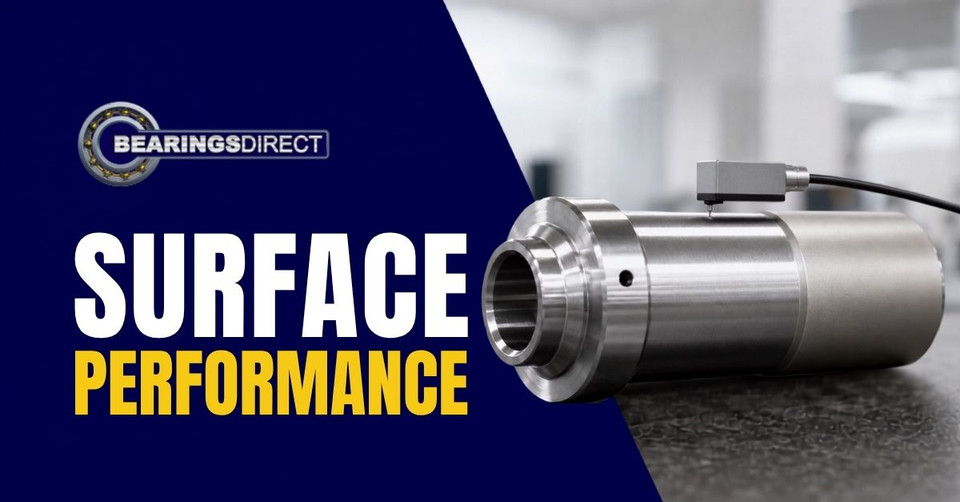
How Surface Finish Affects Custom Component Performance: Ra Values, Coatings & What to Specify
A bearing seat can measure perfectly on every gauge and still fail within weeks, and more often than not the real culprit isn't the dimension at all; it's the surface finish; the microscopic texture Ra is built to measure and put into words.
What Is Surface Finish and Why Does It Matter for Custom Components?
Surface finish describes the tiny peaks and valleys left on a machined surface by whatever cutting process made it. You can't see this texture with the naked eye, but it's there on every turned, milled, or ground part you order, and it has a real effect on how that part performs.
Engineers measure surface finish with a couple of key parameters. Ra, short for roughness average, is the most common one. It takes all the peaks and valleys on a surface and averages them into a single number. Rz, average maximum height, looks instead at the height difference between the highest peaks and lowest valleys across several sample lengths. Ra tells you the general texture, while Rz flags the extremes, and for some applications you need both.
Why does any of this matter? Surface finish influences friction, sealing capability, coating adhesion, fatigue life, and corrosion resistance, all at once. Get it wrong and you'll see the consequences show up in ways that are easy to blame on something else: a bearing that wears out early, a seal that weeps fluid it shouldn't, or a coating that flakes off within months of installation. In every one of those cases, the dimension on the print was probably fine. The surface finish custom components actually shipped with wasn't. This is exactly why surface finish for precision components deserves the same attention on a drawing as bore diameter or overall length.
How Are Ra Values Used to Specify Surface Finish?
Ra is the arithmetic mean deviation of the surface profile, which is a technical way of saying it's a single number that captures how rough or smooth a surface is on average. The lower the number, the smoother the surface.
Here's roughly how common Ra ranges map to real applications:
|
Ra Range |
Typical Surface |
Common Applications |
|
0.1 to 0.4 µm |
Precision ground |
Bearing raceways, sealing faces |
|
0.8 to 1.6 µm |
General machined |
Interference fits, bearing housings |
|
3.2 to 6.3 µm |
Standard machined |
Structural or non-critical surfaces |
These Ra values for machined parts aren't arbitrary. A bearing raceway needs a very smooth finish because any roughness translates directly into friction and wear at the contact point. A structural bracket, on the other hand, doesn't need that level of polish, and specifying it anyway just adds cost for no functional benefit.
On engineering drawings, Ra gets called out using standardized surface finish symbols, most commonly under ISO 1302 or the US equivalent, ASME Y14.36. These symbols are the backbone of clear Ra surface finish specifications, and they tell your machine shop exactly what finish to hit on a given surface, which takes the guesswork out of production. For straightforward parts, Ra alone usually does the job. For more critical applications, like a rotating shaft that needs a specific lay direction or a sealing face where peak height matters as much as average roughness, you may also need to call out Rz and directional finish requirements. Knowing how to specify surface finish at this level of detail is what separates a drawing that produces consistent parts from one that leaves room for interpretation.
How Does Surface Finish Impact Bearing and Component Performance?
Surface finish isn't a cosmetic detail. It changes how a part actually behaves once it's in service.
Friction and wear. A rougher surface has taller peaks, and those peaks concentrate stress at individual contact points instead of spreading load evenly. Under repeated motion, that concentrated stress accelerates wear far faster than a smoother, more evenly distributed surface would.
Sealing performance. Seal lips need a fairly narrow Ra window, typically somewhere around 0.4 to 0.8 µm, to work properly. Too rough and the seal can't maintain contact evenly, which leads to leakage. Too smooth and the surface can't retain the thin oil film the seal actually relies on to function, which shortens seal life in a different way. This is one more area where surface roughness for bearings and sealing surfaces has to be dialed in precisely rather than estimated.
Press fit and interference fit integrity. When you press a component into an interference fit, the surface peaks get crushed down slightly during assembly. That crushing reduces the actual interference you end up with, so a rougher finish can quietly weaken the holding force of a press fit that looked fine on paper.
Fatigue resistance. Every peak and valley on a rough surface is a potential stress concentration point. Under cyclic loading, cracks tend to start at these points, so a smoother finish generally means a longer fatigue life for parts that see repeated stress cycles. Across all five of these factors, surface finish and component lifespan move together more closely than most buyers expect.
Corrosion susceptibility. Rougher surfaces have more places for moisture, salts, and other contaminants to collect and stay put. That trapped material accelerates corrosion, especially in harsh or washdown environments, which is one more reason surface finish and component lifespan are so closely linked.
What Coating and Surface Treatment Options Are Available for Custom Components?
Coatings and surface treatments get applied for a handful of reasons: corrosion protection, added hardness, reduced friction, or even restoring a worn dimension back to spec. Here's a rundown of the most common coating options for custom components.
Hard chrome plating is one of the most common forms of bearing surface treatment, adding wear resistance and restoring dimension on worn shafts and bores. It's a proven option, though RoHS and REACH regulations affect where and how it can be used, so it's worth checking compliance requirements early.
Electroless nickel deposits a uniform layer even on complex geometries, which makes it a strong choice for parts with tight internal features. It also holds up well against corrosion in chemically aggressive environments.
Black oxide provides mild corrosion resistance and cuts down on light reflection. You'll see it most often on tooling and fasteners where a heavier coating isn't necessary.
PTFE and dry film lubricants reduce friction without needing a wet lubricant, which makes them a good fit for low load applications or cleanroom environments where liquid lubricants aren't practical.
Zinc phosphate works well as a paint adhesion primer and offers light corrosion protection on carbon steel parts, often as a step before a final coating is applied.
Anodizing, used specifically on aluminum, increases surface hardness and improves corrosion resistance without adding a separate material layer in the traditional sense.
One detail that's easy to overlook: coatings add material thickness. If you're speccing custom bearing coatings on a part with a tight tolerance, that added thickness has to be accounted for at the design stage, or the finished part will end up out of spec even though the base machining was correct.
How Should Engineers Specify Surface Finish on Custom Component Drawings?
Getting the right part back starts with a clear drawing. A few best practices go a long way here.
Place surface finish symbols directly on the surfaces they apply to and make it clear whether you're calling out an all-over finish or a localized requirement on just one feature. If a part has multiple critical surfaces, like a ground bearing seat, a turned OD, and a milled flange face, each one may need its own finish callout, since a single blanket spec rarely fits every surface on a complex part.
It also helps to note the manufacturing process you expect, whether that's grinding, turning, honing, or lapping, since each process produces a different surface texture and lay direction, even at the same Ra value. This is part of what falls under custom component manufacturing tolerances, and it's a detail that experienced machine shops pay close attention to.
Vague callouts like "smooth finish" or "as machined" leave far too much open to interpretation, and they're one of the most common reasons parts come back out of spec. Specifying an actual Ra value removes that ambiguity and gives your supplier something concrete to machine and measure against, which is really the heart of good Ra surface finish specifications.
For coated parts, be specific about whether the Ra value applies before coating, after coating, or both. Since coatings add thickness and can change surface texture slightly, this distinction matters more than it might seem at first glance.
What Surface Finish Standards Apply to Precision Components and Bearings?
A handful of standards govern how surface finish gets specified and measured across industries.
ISO 1302 is the international standard for indicating surface texture on technical drawings, and it's widely used outside the US. ASME Y14.36M is the US equivalent, covering the same ground with its own symbol conventions. Together, these standards are why a Ra surface finish specifications callout means the same thing to a machinist in one country as it does in another.
ISO 4288 and ASME B46.1 cover the measurement side, including instrument cutoff lengths and evaluation methods, so that roughness readings stay consistent no matter who's measuring the part.
Certain industries layer additional requirements on top of these general standards. Aerospace work often falls under AS9100, medical devices under ISO 13485, and semiconductor equipment frequently demands tighter finish windows than typical industrial parts require. This is where surface finish for precision components really separates itself from general industrial work, and it's worth flagging that requirement early so your supplier can plan for the tighter window from the start.
Bearings Direct verifies finish requirements through in process inspection and measurement, so you're not left hoping the part matches spec once it arrives. Confirming surface roughness for bearings at each stage of production catches problems before they become a shipped part.
Why Partner with Bearings Direct for Custom Components with Precise Surface Finish Requirements?
Bearings Direct machines, finishes, and coats custom components to the Ra values your drawing calls for, all in house, with strict custom component manufacturing tolerances held at every step. A few reasons engineering and procurement teams choose us for parts where finish really matters:
- Experience supplying custom components to industries with strict finish requirements, including aerospace, medical, and industrial automation
- Engineering support to help you define the right finish specification when a drawing is incomplete or still being developed
- Full traceability and inspection documentation available on request
- Fast turnaround on both prototypes and production runs, with no minimum order quantity barriers standing in the way of custom work
Whether you're locking down bearing surface treatment on a shaft or choosing between coating options for custom components on a housing, our team can help you land on a spec that performs the way it's supposed to.
Frequently Asked Questions
1. What's the difference between Ra and Rz? Ra averages all the peaks and valleys across a surface into one number, while Rz looks at the height difference between the highest peak and lowest valley within sample lengths. Ra gives you a general picture, and Rz flags the extremes, which matters more for some applications than others.
2. What Ra value should I specify for a bearing bore? It depends on the application, but among typical Ra values for machined parts, bearing raceways and other precision surfaces usually fall in the 0.1 to 0.4 µm range. General machined bearing housings can often use a rougher finish, closer to 0.8 to 1.6 µm, without affecting performance.
3. Can surface finish be improved after machining? Yes. Secondary processes like grinding, honing, lapping, or polishing can refine a surface beyond what standard machining achieves on its own, and some coatings also change the final surface texture.
4. Does a smoother finish always mean better performance? Not always. Extremely smooth surfaces can actually struggle to retain a lubricating oil film in some applications, so the right finish is the one that matches the application, not simply the lowest Ra number available.
5. How do coatings affect dimensional tolerances? Coatings add a layer of material on top of the base surface, which changes the final dimension slightly. This needs to be factored into your design, so the finished, coated part still falls within your required tolerance.
6. What's the most common surface finish standard used in the US? ASME Y14.36M is the standard most commonly referenced on drawings in the United States, while ISO 1302 is more common internationally. Many custom manufacturers, including Bearings Direct, work comfortably with both.
7. Do I need to specify surface finish separately from dimensional tolerance? Yes. Dimensional tolerance controls size, while surface finish controls texture. A part can be perfectly within its dimensional tolerance and still have the wrong surface finish for its application.
8. What happens if I just write "smooth finish" on my drawing? Vague callouts like that leave room for interpretation, and different shops may deliver very different results. If you're not sure how to specify surface finish correctly, an actual Ra value or standard finish symbol removes the ambiguity and gets you a consistent, repeatable part.
9. Which coating is best for corrosion resistance? It depends on the base material and environment, but electroless nickel and hard chrome plating are both strong choices among custom bearing coatings for corrosion resistance, while anodizing works specifically well on aluminum components.
10. Can Bearings Direct help me choose a finish if my drawing doesn't specify one? Yes. Our engineering team regularly helps customers define the right surface finish and coating specification from scratch, especially for first-run parts or designs that are still being finalized.
Ready to Specify Custom Components with the Right Surface Finish?
Whether you're locking down Ra values for a bearing seat, choosing a corrosion-resistant coating, or starting from a rough concept with no finished drawing yet, Bearings Direct's engineering team can help you define the right finish for your application and manufacture it to spec. Browse custom components at bearingsdirect.com or contact our team today for a quote.